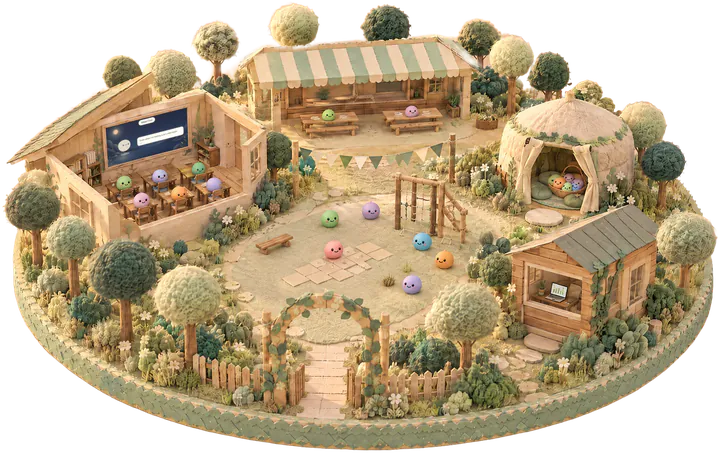


What we know so far

What happened in schools using Orli, one school in detail, and our research. Every finding says who answered, how we asked and what it can’t show yet.

How to read the figures

Self-report
What staff and pupils told us when we asked. Useful, but not the same as measured change.
Respondents
How many people answered. Where a source doesn’t give that number, we say so.
Limitations
Every set of figures ends with what it can’t tell you.

Eight schools in Sunderland

Our Early Adopter Programme ran from May to July 2026, delivered with Together for Children.

What took place

  • 8 schools
  • 286 pupils
  • 21 groups
  • 103 sessions
  • 18 staff trained

Counts of what was delivered, not results.

What staff and pupils told us

  • 100% of participating pupils said they felt a stronger sense of belonging at school

    Question
    Not confirmed yet
    Who answered
    Pupils
    Method
    Self-report
    How many
    Still being checked (286 pupils took part)
  • 97% of children said they feel more ready to learn

    Question
    Not confirmed yet
    Who answered
    Pupils
    Method
    Self-report
    How many
    Still being checked (286 pupils took part)
  • 91% of sessions rated effective by staff

    Question
    Not confirmed yet
    Who answered
    Staff, about their sessions
    Method
    Staff rating
    How many
    Still being checked (103 sessions delivered)
  • 75% of staff said Orli cut planning time and helped manage behaviour incidents

    Question
    Not confirmed yet (one question or two?)
    Who answered
    Staff
    Method
    Self-report
    How many
    Still being checked (18 staff trained)

Source: Orli Early Adopter Programme, May to July 2026. Source 1

What these figures can’t tell you

  • They count what was delivered. They don’t show what changed for children.
  • Staff and pupil feedback is self-report: answers people gave, not measured change. It can’t show what caused a change.
  • We’re still checking how many answered each question, so a percentage may describe only the people who answered.
  • Showing that Orli made a difference needs measures before and after, and ideally a comparison group.
  • One staff question asks about two things at once (planning time and behaviour incidents), so its answer can’t separate them.

One school, in more detail

A whole-school rollout at a Sunderland primary, Years 1 to 6, and what it hasn’t proven yet.

[VERIFY] Written consent to name the school and publish this case study and the headteacher’s words.

Gillas Lane Primary School

One shared language, every classroom
Pupils
104
Year groups
1–6
Staff
6
Sessions
48
Length
10 weeks
Delivery
Whole class
Read the full case study

The challenge

  • Staff were deeply committed to pupil wellbeing, but the school had no shared whole-school framework for emotional literacy and regulation.
  • Approaches varied from classroom to classroom, depending on each member of staff’s confidence, experience and time.
  • Some pupils found it hard to recognise, communicate and manage their emotions, which affected readiness to learn and relationships.

What we did

  • An in-person discovery session with leaders and staff to understand existing provision, pupil needs and barriers.
  • Physical and digital resources delivered to the school.
  • An online onboarding session so every teacher understood the programme before it began.
  • Orli staff modelled lessons and team-taught, until the school’s Orli Champion led delivery independently.

What happened

At the start of each session pupils collected their physical Orli and used it through the check-in and activities. Talking through their character meant they did not always have to speak directly about themselves.

Children now use Orli’s language and strategies beyond the classroom: in the playground, at home and in everyday conversation.

[VERIFY] Held: this could identify a pupil. Needs the school’s written consent.

One moment

A boy who had been interviewed during an Orli visit chose to speak about the programme when he received an award in assembly, in front of parents and the whole school. He talked about what he does when big feelings come, and proudly told everyone the name of his Orli character.

What pupils and staff told us

Results will appear here once each one has its question and how many people answered.

Method
Self-report at the end of the pilot
Who answered
Pupils in Years 1, 3 and 4, and staff
Respondents
Not yet published

The children really value the use of Orli in school, and it is making a huge difference to them.

Headteacher, Gillas Lane Primary School

What we haven’t proven yet

  • End-of-pilot pupil feedback was collected from Years 1, 3 and 4, so it does not represent every pupil or year group.
  • We have no baseline or longitudinal data yet. Tracking change over time needs start, midpoint and end measures.

Source: Gillas Lane Primary School case study. Source 2

[VERIFY] Held until the school’s written consent is on file. Anonymised for review.

A 1:1 pilot in a secondary setting

The pupil who never said no to a session

Secondary schools are outside our primary focus.

Orli is made for primary schools. This pilot was with one pupil in a secondary SEMH setting in the North East. Names and identifying details are withheld.

Setting
Secondary SEMH
Pupils
1
Sessions
5 in 6 weeks
Delivery
Weekly 1:1
Read the full case study

The challenge

  • A pupil who had found it hard to come to school.
  • Getting him to join in 1:1 sessions was hard, so staff looked for something structured that he could lead.

What we did

  • Weekly one-to-one sessions with the school’s SEMH practitioner.
  • The first and longest session was making his own Orli character, which caught his interest straight away.
  • Later sessions mixed booklet work with more time on his character, covering noticing and settling feelings, belonging and getting organised.

What happened

From the first session he joined in more than his practitioner had often seen. He has never once refused a session, which matters for a young person who would usually walk away from anything that didn’t interest him.

He made a character of his own rather than a copy of himself, and took real ownership of it. He holds it while they talk and once built it a chair out of a water bottle.

The character has become a way into talking about feelings. Instead of being asked straight out how he feels, he talks through his Orli, which is gentler for a young person who finds that conversation hard.

Looking ahead

The practitioner is extending 1:1 sessions to more pupils and exploring small morning groups. We’ve proposed an action research project with the school, to gather better data.

What the practitioner told us

  • Strongly agree Orli reduced planning time for SEL sessions
  • Strongly agree Wellbeing sessions were easier to facilitate
  • Strongly agree Pupils could better understand and talk about emotions
  • Agree More confident supporting pupils with SEMH and SEND
Method
Practitioner self-report
Who answered
The SEMH practitioner
Respondents
1

He’s never refused a session — and with this student, that means everything. If he’s not interested, he walks. With Orli, he’s always there.

SEMH practitioner, a secondary school in the North East

What we haven’t proven yet

  • This is one pupil and one practitioner, so the findings are directional rather than evidence of outcomes across a cohort.
  • Wider changes in behaviour incidents and sense of belonging were not evidenced. Responses there were neutral.
  • The window was short, with no baseline, midpoint or end-of-intervention data.

Source: secondary 1:1 pilot case study. Source 4

[VERIFY] Held until everyone in the film has consented, the speaker’s role is confirmed and a checked transcript exists. It may sit better on About.

In a school leader’s words

A school leader on why they chose Orli. Their role and school to be confirmed. Nothing loads from YouTube until you press play. The video then plays in YouTube’s privacy-enhanced mode.

Our research with Thiscovery

In late 2024 we asked parents, carers, educators and health workers what waiting for children’s mental health support is like.

Who took part

131 people

  • 61 parents and carers
  • 36 educators
  • 25 health workers
  • 9 others

How it was done

An online survey on the Thiscovery platform, open from 23 October to 11 December 2024, with mostly open questions.

It received 184 responses. We analysed 131, after removing people who weren’t eligible (9) or didn’t answer any questions (44). A trained researcher analysed the written answers with the help of a text-analysis tool.

Two things they told us

  • 100 of the 120 people who answered disagreed that it’s easy to access the right mental health support for a child

    Statement
    “I think it is easy to access the right mental health support for my/a child or young person”
    Who answered
    Parents and carers, educators and health workers
    Respondents
    120. 100 disagreed or strongly disagreed (83%)
  • 43 parents and carers turned to their child’s school or the education system for support while waiting

    Question
    Which types of support they had accessed while waiting
    Who answered
    Parents and carers (61 took part)
    Respondents
    Not given for this question. The report puts 43 at 72%, the same as for family, friends and community

What this research can’t tell you

  • It’s about waiting for support. It doesn’t measure Orli or its effect on children.
  • People were recruited mainly through Orli’s and Thiscovery’s own networks, so this isn’t a representative sample and the findings can’t be generalised.
  • Fewer health workers took part than planned.

The full report is available on request. Email hello@orli.health.

Source: Orli Insights Report, with Thiscovery (2025). Source 3

What we’re investigating

We think settling big feelings helps children get ready to learn, and that over time this could support achievement. That’s a question we’re testing with schools, not a result.

  1. Notice it, settle it

    Children learn to spot a big feeling and try something that helps.

    So far What staff saw, like the case study above. No measured change yet.

  2. Back in the room

    A settled child can listen, join in and have a go.

    So far Early self-report only (see Sunderland above). Not measured change.

  3. Does it add up?

    Better regulation, over time, supporting achievement.

    So far No evidence yet. This is the question we’re investigating.

How we’ll measure it

  • A short, playful check-in children do with their own Orli, about things like belonging and feeling ready to learn. We’re designing it with pilot schools, and the wording isn’t final.
  • A repeat check-in later in the year, so schools can see what’s changed.
  • Orli Intelligence for school leaders, starting with what’s been delivered and who took part. No wellbeing scores and no league tables.
  • The check-in won’t measure learning or test results, so looking at achievement will need separate research with schools.

What we won’t claim

  • That Orli raises attainment, attendance or behaviour. We haven’t shown that.
  • That a percentage describes every child. We’ll give how many answered as soon as it’s checked.
  • Any clinical effect. Orli is a classroom tool, not therapy.

See what KCSIE 2026 asks of any intervention.

We’ll share what we learn, including what doesn’t work.

Sources

  1. Orli Early Adopter Programme, May to July 2026. Eight schools in Sunderland, delivered with Together for Children. 103 sessions, 286 pupils, 21 groups, 18 staff trained. Staff and pupil self-report. Internal report, available on request.
  2. Orli. Gillas Lane Primary School: whole-school Orli rollout, Years 1 to 6, Sunderland. Case study. Internal report, available on request.
  3. Cox M, Bell E (2025). Developing better support for parents, families and carers of children waiting for mental health services. Orli Insights Report, with Thiscovery. Report available on request.
  4. Orli. A 1:1 pilot in a secondary SEMH setting in the North East. Case study. Internal report, available on request.
  5. Orli Health. Why schools should partner with Orli. Video on YouTube: youtube.com/watch?v=sElf_K-RAZg

To ask for a report, email hello@orli.health.

Help us find out

Try Orli with a small group of children, free, and tell us what you notice.

Questions about anything on this page? Email hello@orli.health.