Orli in your inclusion strategy

Schools receiving the inclusive mainstream fund must publish an inclusion strategy statement by 31 December 2026. Here’s a plain way to include Orli, if it’s part of your plan.

PDF, A4, 1 page, 233 KB. Or open it to print.
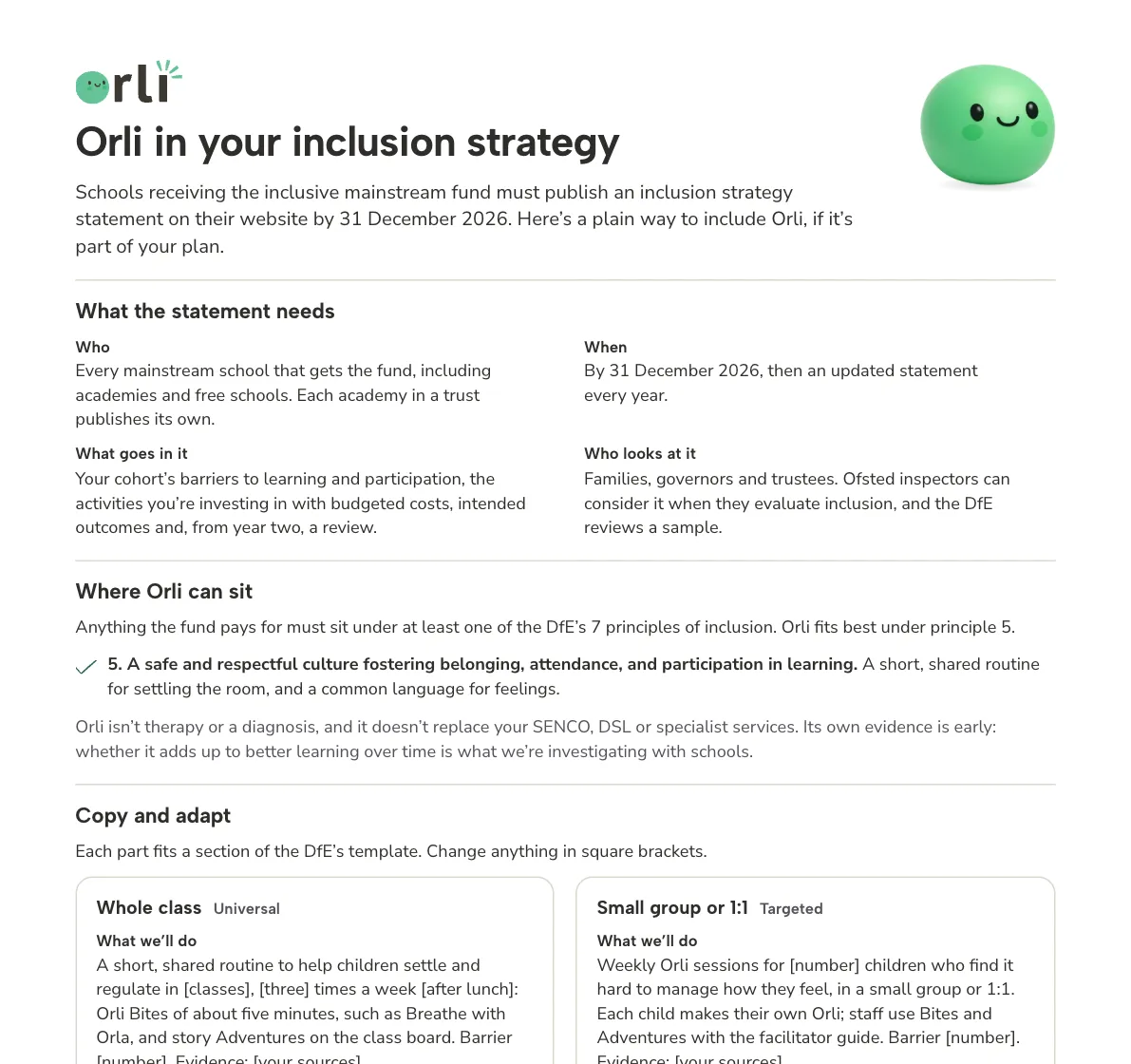
The top of the one-page summary: the Orli logo, the title Orli in your inclusion strategy, and the first sections, What the statement needs and Where Orli can sit.
The one-page summary, ready to print or pass on.

What you need to publish

The Department for Education sets this out in the fund’s conditions of grant and its guidance for school leaders. Here’s the short version.

Who
Every mainstream school that gets the inclusive mainstream fund, including academies and free schools. Each academy in a trust publishes its own statement.
When
By 31 December 2026 for 2026 to 2027. Then an updated statement every year.
Where
On your school website, where families can read it.
What goes in it
  • The barriers to learning and participation you’ve found across your cohort.
  • The activities you’re investing in to remove them, with their budgeted costs.
  • Your intended outcomes, and how you’ll know you’ve reached them.
  • From the second year, a review of the year before.
Who looks at it
Governors and trustees scrutinise it. Ofsted inspectors can consider it when they evaluate inclusion, and the DfE reviews a sample of statements.
Keep it focused
In this first year, the DfE recommends most schools focus on a small number of activities that will make the biggest difference.

Where Orli can sit in your strategy

Anything the fund pays for must sit under at least one of the DfE’s 7 principles of inclusion. Orli fits most naturally under principle 5, a culture of belonging. With a small group, it can also sit under principle 2. The rest of your strategy carries the others.

Principle 5

A safe and respectful culture fostering belonging, attendance, and participation in learning

Where Orli fits

A short, shared routine for settling the room, and a common language for feelings that every child in the class can use.

Principle 2

Evidence-based support prioritising early intervention

Also fits

Small-group or 1:1 time for children who find it hard to manage how they feel, started from what staff notice, with no diagnosis needed. Say what evidence you’ve drawn on, and how you’ll check it’s working.

Orli’s own evidence is early. See what we know so far

The other five principles

  • Principle 1

    Ambitious leadership and governance that embeds inclusion

  • Principle 3

    High quality adaptive teaching with curriculum designed for all learners

  • Principle 4

    Enriching provision beyond the classroom that all children can access

  • Principle 6

    Strong partnerships with families and wider services

  • Principle 7

    Inclusive environments with continuous improvements to accessibility

The principles in the DfE’s words, from Developing an inclusion strategy using the inclusive mainstream fund (updated 7 August 2026).

How Orli maps to Ofsted and DfE guidance

What Orli is, and isn’t

Describe Orli as it is today. Everything in the first list is live in Orli Schools now.

How Orli works in school

What you’d be describing

  • Orli Bites: short activities of about five minutes, such as Breathe with Orla.
  • Adventures: story sessions on the class board, each showing one thing that helps.
  • For a class, a small group or one child. In small groups, each child makes their own Orli.
  • A facilitator guide beside every session, run from a laptop.
  • One licence for the whole school, with no per-staff or per-pupil seats.

What it isn’t

  • Therapy or counselling.
  • A diagnosis. Orli doesn’t assess or label children.
  • A replacement for your SENCO, your DSL or specialist services.
  • Proof of impact. Whether better regulation adds up to better learning over time is what we’re investigating with our partner schools.

A short check-in children do with their Orli, and a view for school leaders, are being built with pilot schools. They aren’t ready to write into this year’s strategy.

A short template you can copy

Three parts: what we’ll do, who it’s for and how we’ll know. Each fits a section of the DfE’s own template. Change anything in square brackets.

With a whole class Universal

What we’ll do
Use Orli as a short, shared routine to help children settle and regulate in [classes or year groups], [three] times a week [after lunch]. Staff run Orli Bites of about five minutes, such as Breathe with Orla, and story Adventures from a laptop on the class board, so children build a shared language for feelings. Addresses barrier [number]. Evidence we’ve drawn on: [your sources].
Who it’s for
Universal: every child in [classes or year groups].
How we’ll know
Intended outcome: [children can name how they feel and choose one thing that helps]. Success criteria: [the routine runs three times a week by February half term]; [staff notice classes settle more quickly after lunch, reviewed each half term]; [more children say there’s an adult they can talk to, in our own pupil survey].
Principle
[A safe and respectful culture fostering belonging, attendance, and participation in learning]
Budgeted cost
[£ from the inclusive mainstream fund] + [£ from our core budget]

With a small group or 1:1 Targeted

What we’ll do
Run weekly Orli sessions for a small group of [number] children who find it hard to manage how they feel, or 1:1 where that suits a child better. Each child makes their own Orli. Staff use Orli Bites and Adventures, with the facilitator guide beside them. Addresses barrier [number]. Evidence we’ve drawn on: [your sources].
Who it’s for
Targeted: [number] children in [year groups], chosen by [class teachers and our SENCO] from what staff see day to day, without waiting for a diagnosis.
How we’ll know
Intended outcome: [children in the group notice how they feel and use one thing that helps, with less adult support]. Success criteria: [at least X of Y planned sessions run by Easter]; [staff note when a child uses a strategy on their own]; [time out of class for the group, autumn and spring, from our own records].
Principle
[Evidence-based support prioritising early intervention]
Budgeted cost
[£ from the inclusive mainstream fund] + [£ from our core budget]

Where each part goes in the DfE template

What we’ll do
“Description of activity (noting evidence and barrier numbers addressed)”
Who it’s for
“Activity type (whether it is universal or targeted)”
How we’ll know
“Intended outcome” and “Success criteria”
Budgeted cost
“Total budgeted cost”, counting spend from the fund and your core budget

You decide which principle an activity sits under and what evidence supports it for your pupils.

Whether the fund pays for any activity, Orli included, is your school’s decision under the conditions of grant. They rule out using it to subsidise spending on activity you already run, so check with your business manager before you budget.

One Orli licence covers the whole school. Ask us for a quote.

How your allocation is worked out

Your school’s actual figure for 2026 to 2027 is in the DfE’s published allocations. This shows the formula behind it, so you can check the figure or plan with it.

Find your school’s allocation on GOV.UK

Work it through

Phase

The DfE uses the October 2025 census. For secondary, count pupils up to age 16.

The DfE takes this from your local authority’s 2025 to 2026 funding data (the authority proforma tool). Your business manager can find it.

Between 1.00 and 1.18 for schools, depending on your local authority. Leave it at 1.00 if you’re not sure.

Starts with example figures. Change them to your school’s.

Estimated allocation

Lump sum
£3,000
210 pupils × £16
£3,360
20% of 210 pupils × £79
£3,318
Before the area cost adjustment
£9,678
× area cost adjustment
1.00

For 2026 to 2027, about £9,678

(£3,000 + pupils × the per-pupil rate + pupils with low prior attainment × the LPA rate) × your area cost adjustment, rounded to the nearest pound.

  • An estimate, not your allocation. The DfE has published actual allocations, and on 1 July 2026 it removed its own calculator.
  • The DfE uses pupil numbers from the October 2025 census and low prior attainment proportions from the 2025 to 2026 authority proforma tool.
  • Schools that opened in September 2026, growing schools and schools closing during the year are funded differently.
  • Maintained schools are paid through their local authority. Academy trusts are paid directly.

Sources

Checked 19 October 2026. This page is a summary, not official guidance. If anything here differs from GOV.UK, GOV.UK is right.

Try Orli before you write it in

A free trial with a small group shows you whether Orli suits your pupils before it goes into your strategy.